
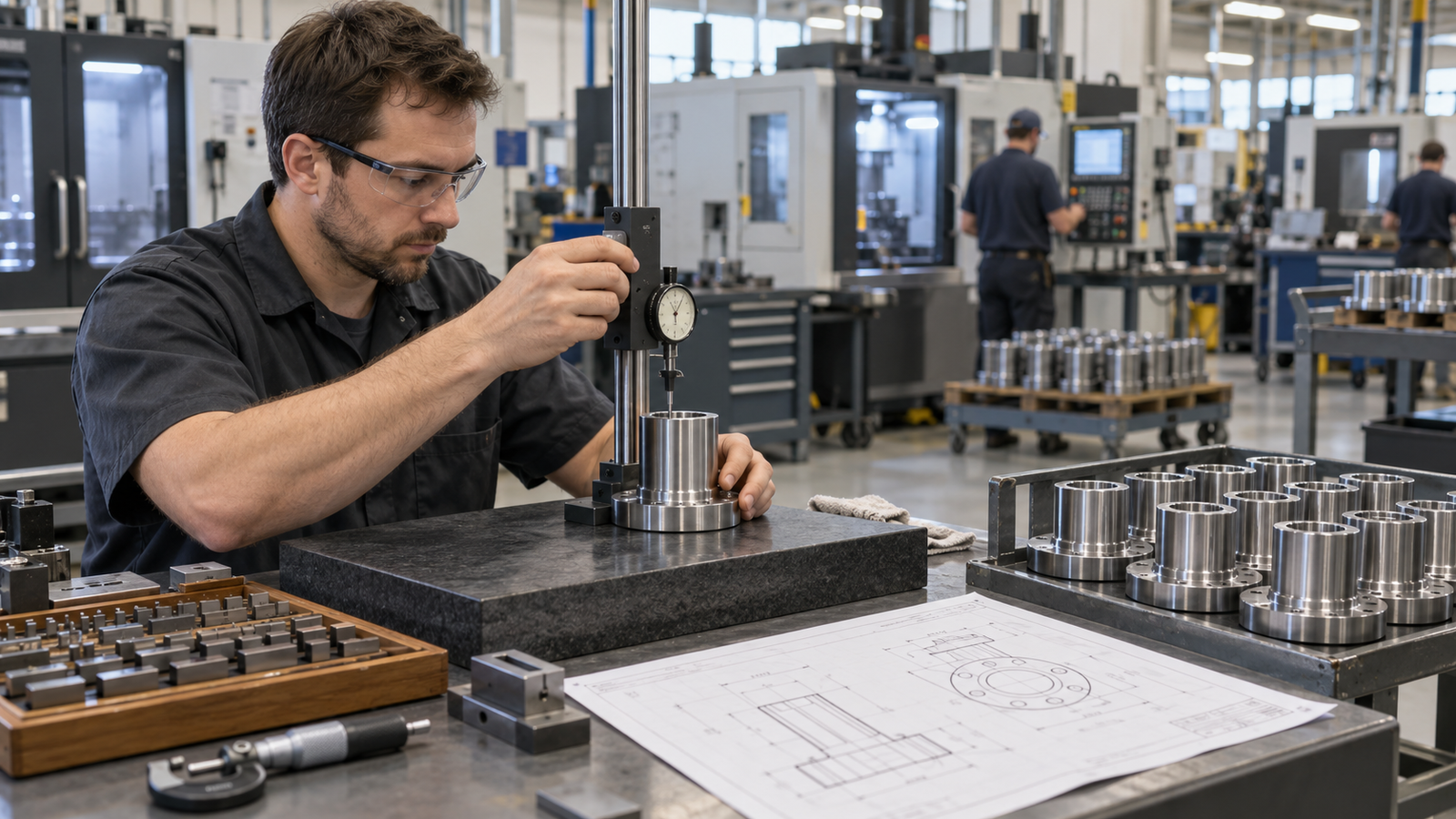
Mass production depends on a quiet idea: two parts made at different times need to fit the same way.
That sounds obvious now. It was not always easy. Repeatable manufacturing required advances in machine tools, measurement, gauges, process control, drawings, materials, and standards.
Interchangeability is a system, not a slogan
Interchangeable parts are components made closely enough to a common specification that one can replace another without custom fitting.
That requires more than a clever machine. Manufacturers need agreed dimensions, tolerances, inspection methods, and measurement standards.
Measurement made repeatability possible
NIST’s history of manufacturing measurement highlights the importance of precision gauges and gauge blocks. Standardized gauge blocks gave manufacturers reliable references for checking dimensions and helped support closely controlled interchangeable parts.
Once factories could measure parts consistently, they could separate production from fitting. The person making one component did not need the mating component sitting beside the machine.
Standards reduced ambiguity
Manufacturing standards can define dimensions, thread forms, material properties, interfaces, test methods, and performance requirements.
NIST notes that agreed standards help businesses transact using common criteria. In practical terms, a supplier can make a threaded component, gauge, bearing seat, or material to a specification that a customer understands without inventing a new language for every order.
Drawings became manufacturing contracts
A good technical drawing communicates geometry, dimensions, tolerances, material, finish, and inspection requirements.
As drawing practices and standards improved, work could move among departments and suppliers with less dependence on one craftsperson’s memory.
Gauges brought the standard to the shop floor
Production workers do not need to recreate a national measurement standard every time they check a part. Calipers, micrometers, plug gauges, ring gauges, fixtures, and gauge blocks transfer traceable measurement into practical inspection.
Go/no-go gauges are a good example. Instead of reading a number, an operator can quickly determine whether a feature is within an accepted limit.
Standardization enabled supplier networks
Once specifications became repeatable, companies could buy parts from specialized suppliers rather than making everything under one roof.
That helped create deeper manufacturing ecosystems: fastener makers, bearing suppliers, tool companies, heat treaters, foundries, machine shops, and other specialists could serve multiple customers.
Standardization does not mean every product becomes identical
Standards create common foundations. Companies still compete on design, material choices, process capability, quality, cost, service, and innovation.
A standard screw thread can be used in thousands of different products. The shared interface makes variety easier, not harder.
The history is more complicated than one inventor
Popular manufacturing history sometimes assigns interchangeable parts to a single person or factory. The real development was gradual. Machine tools, military procurement, inspection systems, gauges, standards organizations, and factory practice all contributed.
That more complicated history is more useful because it shows how manufacturing capability actually grows: through systems that reinforce each other.
The practical takeaway
Standardization helped American manufacturing scale because it made repeatability portable.
Parts could be specified, measured, inspected, bought from suppliers, assembled in volume, and replaced later. The result was not simply faster production. It was an industrial language that allowed many different companies and workers to make compatible things.
Sources
https://www.nist.gov/speech-testimony/standards-and-infrastructure-forum-new-directions-manufacturing
https://www.nist.gov/system/files/documents/nvl/MP275_09_Chapter_IV-__THE_WAR_YEARS.pdf