
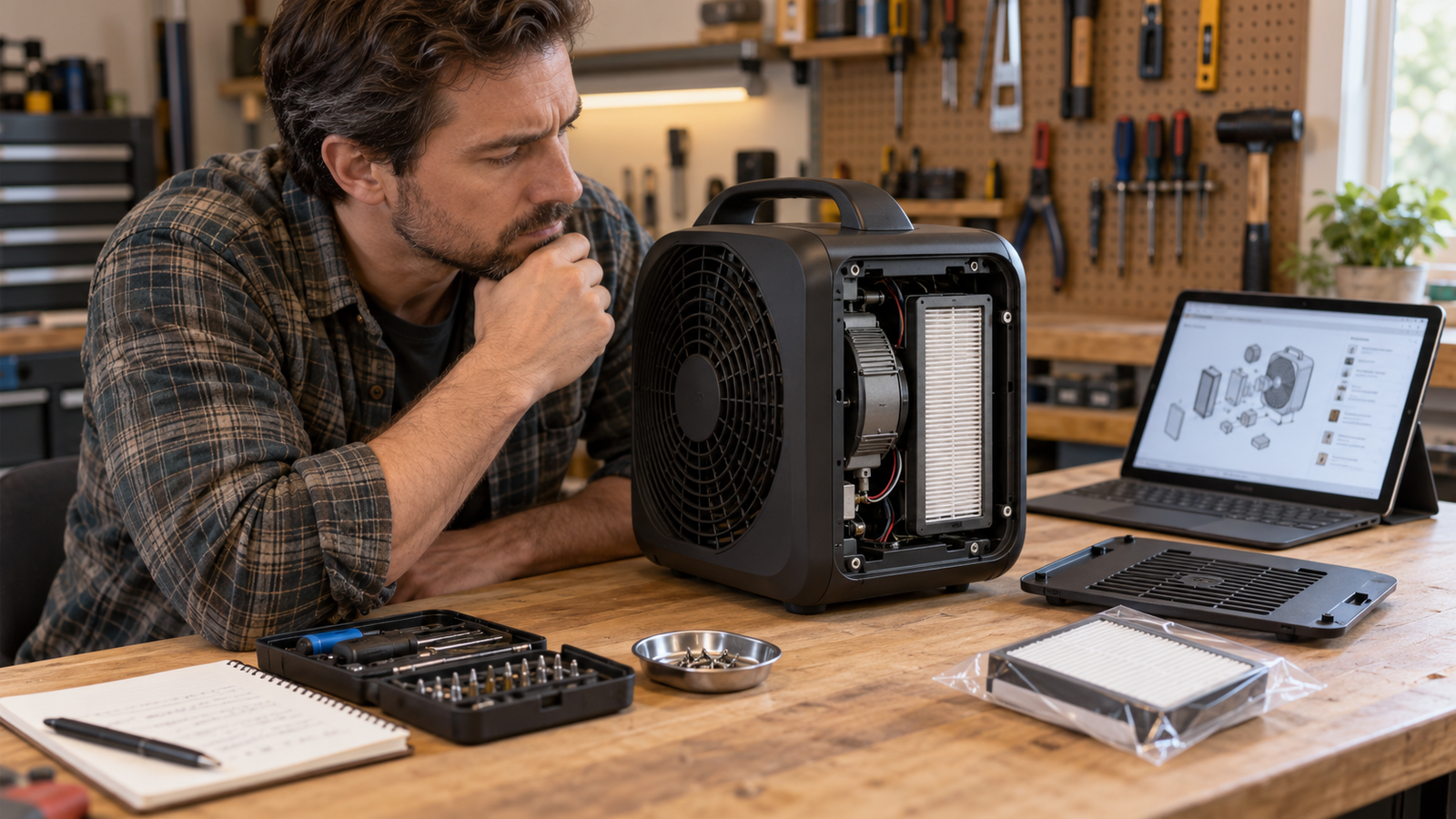
Repairability is easiest to evaluate before the product fails.
Once something is broken, you are under time pressure. Before you buy, a few minutes of checking can tell you whether a product was designed to stay in service or to become difficult after the first major failure.
1. Can the product be opened without damage?
Look for screws, bolts, clips, removable panels, and accessible service points. Permanent adhesives and welded housings can make ordinary repairs harder, although sealing can be justified for safety, water resistance, or structural reasons.
2. Are the fasteners ordinary?
Standard Phillips, Torx, hex, slotted, or socket fasteners are easier to support than proprietary fasteners requiring a tool available only to authorized service centers.
3. Are common wear items replaceable?
Check batteries, belts, bearings, brushes, filters, seals, cords, switches, blades, pumps, and other predictable failure points.
A durable housing does not help much if the one component expected to wear out is permanently built in.
4. Can you actually buy the parts?
Search the manufacturer’s parts site before purchase. Look for model-specific diagrams, prices, and availability.
The FTC has identified restricted access to replacement parts as one of the barriers that can limit independent repair.
5. Is there a clear model number?
A stable model identifier makes it easier to find manuals, service bulletins, parts, and compatible accessories years later.
6. Is service information available?
Look for:
- Owner’s manual
- Troubleshooting guide
- Exploded parts diagram
- Service manual
- Error-code list
- Wiring or hose diagrams where appropriate
7. Does software create an extra barrier?
Some modern products require software pairing, calibration, authentication, or proprietary diagnostics after a physical part is replaced.
A component can be mechanically replaceable and still be functionally blocked.
8. Are independent repair options available?
Search for local repair shops before the warranty is over. A product with several service paths is less dependent on one company keeping one service program alive forever.
9. What does the warranty really say?
FTC guidance explains that companies generally cannot void a warranty solely because a consumer uses an independent repair service or third-party part. A company can still deny coverage for damage actually caused by that part or repair.
10. Does the manufacturer support older models?
Look at products from five or ten years ago. Are parts and manuals still available? Past support is not a guarantee, but it is useful evidence.
11. Are consumables standardized?
Filters, blades, batteries, belts, and accessories that use common sizes or widely available standards are usually easier to source over time.
12. Is repair economically sensible?
A product can be technically repairable but uneconomical to fix if a replacement assembly costs almost as much as the entire product.
Check parts prices and labor access, not just whether disassembly is possible.
A quick scorecard
Before buying a product you expect to keep, ask:
- Can I open it?
- Can I identify the failed part?
- Can I buy that part?
- Can I find instructions?
- Can an independent shop work on it?
- Will software allow the repair?
- Will the repair cost make sense?
The practical takeaway
Repairability is not about doing every repair yourself. It is about preserving options.
A good product gives the owner, technician, or independent shop a realistic path from diagnosis to replacement part to working product.
Sources
https://www.ftc.gov/reports/nixing-fix-ftc-report-congress-repair-restrictions
https://www.ftc.gov/nixing-the-fix-call-for-research
https://www.ftc.gov/business-guidance/blog/2019/03/nixing-fix-warranties-mag-moss-restrictions-repairs