“Every dollar is a vote” is a good slogan. It is also a little too simple.
A purchase is not a ballot, and no single T-shirt changes the national economy. But purchases do create demand, and demand determines which suppliers receive orders, which production lines stay busy, and which businesses have a reason to expand.
That is the practical case for buying American.
You are supporting a chain, not just one company
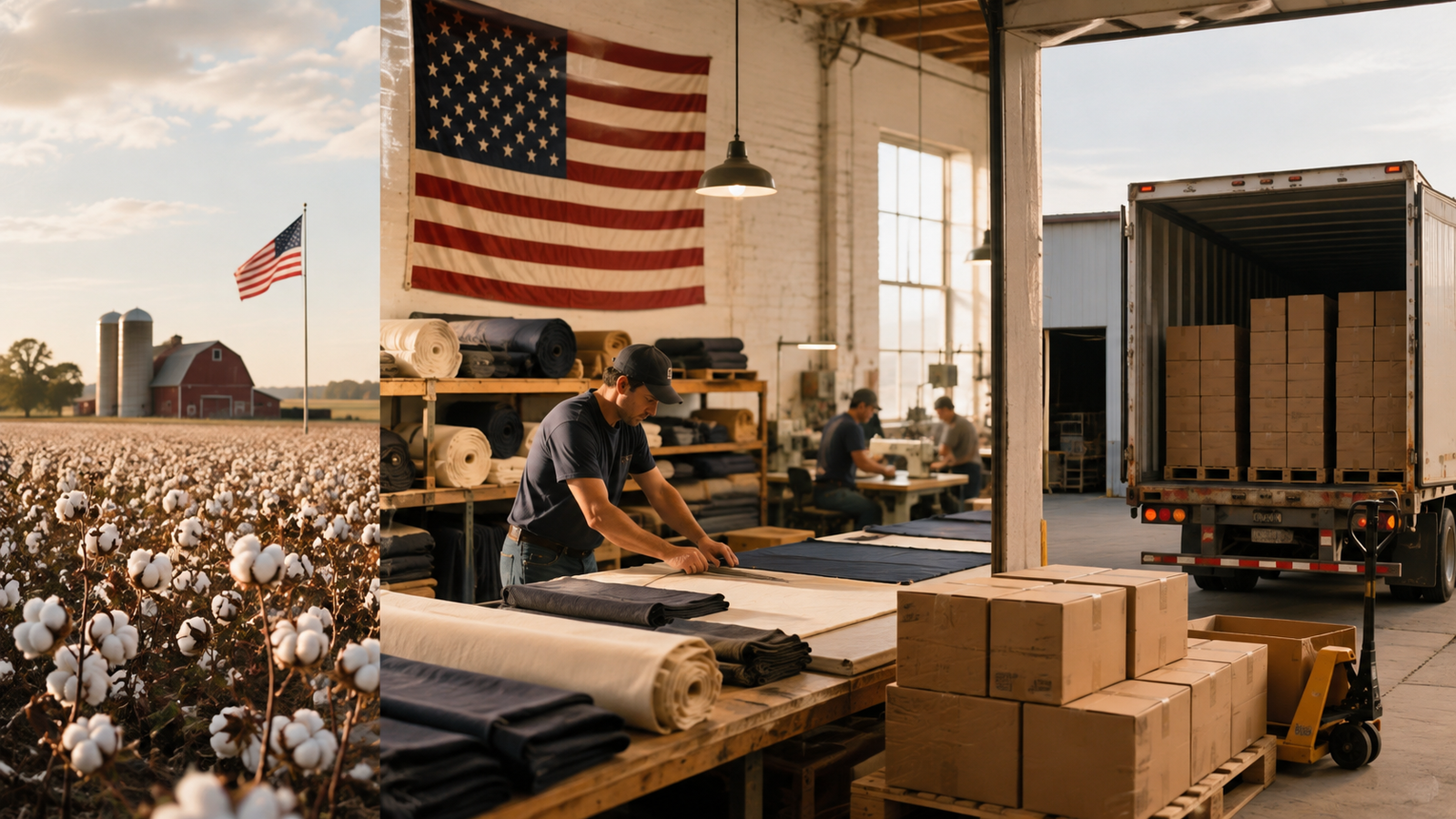
Take a cotton T-shirt. The finished product may connect agriculture, ginning, yarn, fabric production, dyeing and finishing, cut-and-sew work, printing, packaging, freight, software, banking, and local services.
USDA’s cotton data make the first part of that chain visible. The United States remains a major cotton producer and exporter, and the industry supports activity from farms through textile mills.
When more of the garment chain also happens domestically, more of the purchase touches U.S.-based businesses before the finished shirt reaches the customer.
Price is real, but it is not the only cost
Imported goods can be less expensive for many legitimate reasons, including lower labor costs, enormous production scale, specialized overseas supply networks, and efficient global logistics.
Pretending those differences do not exist does not help anyone.
The better question is what the buyer values. Some people prioritize the lowest possible price. Others are willing to pay more for domestic origin, traceability, durability, shorter supply chains, or the simple preference to support production closer to home.
Neither choice needs to be disguised.
F2R’s job is to make the value proposition clear enough that the customer can decide.
Domestic demand helps preserve domestic capability
NIST’s Manufacturing Extension Partnership spends real effort helping companies identify domestic suppliers and bring portions of supply chains closer to home. That work would make little sense if domestic purchasing had no effect.
Manufacturing capacity is not a switch that can be flipped on during a crisis. It depends on companies, equipment, experienced workers, supplier relationships, and enough ongoing business to keep those systems alive.
That is one of the strongest reasons to care where things are made.
Buying American is a preference we can act on
You do not need to replace everything in your house overnight. You do not need to shame people who cannot afford the more expensive option. And you do not need to pretend every American-made product is automatically superior.
Just start by checking.
When two products meet your needs, look at origin. Look at who made them. Look at whether the company can explain its supply chain. When the American-made option makes sense for your budget, choose it.
That is not performative patriotism. It is a normal consumer preference, repeated often enough to matter.
Quick answer
Does buying American support American jobs? Domestic purchases can support U.S. producers and the supplier networks around them, although the exact effect varies by product and company.
Is American-made always better? No. Origin is one factor alongside quality, price, fit, durability, and service.
Why does F2R emphasize it? Because domestic production is part of the brand’s stated purpose, not a side claim added after the product is made.
Sources
- USDA Economic Research Service: https:/
/ www. ers. usda. gov/ topics/ crops/ cotton- and- wool/ cotton- sector- at- a- glance - NIST Manufacturing Extension Partnership: https:/
/ www. nist. gov/ mep/ supply- chain