
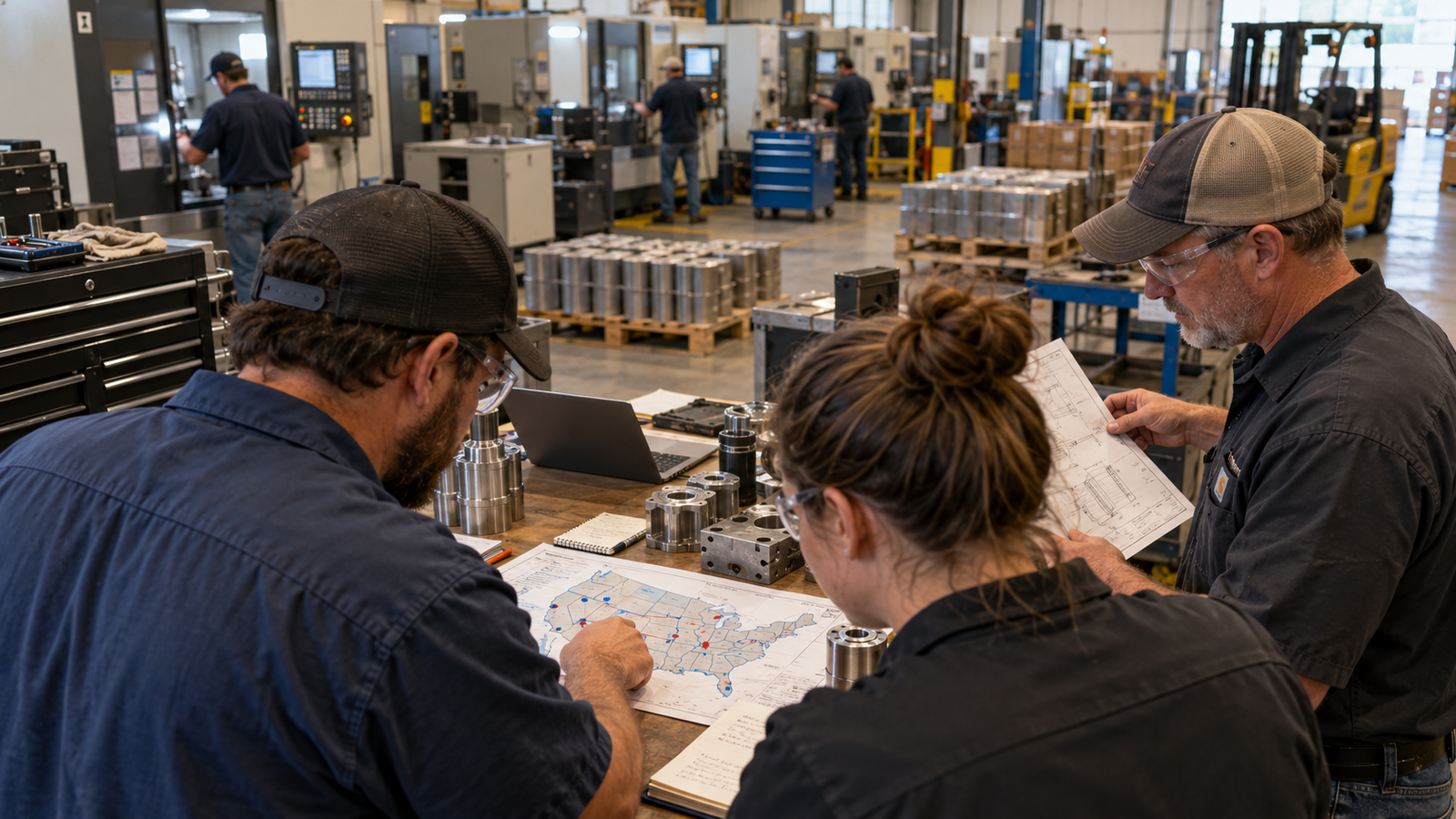
Reshoring means moving production or supply-chain activity back to the United States after it has been performed abroad. Successful reshoring usually requires more than finding a domestic factory. Companies have to understand total cost, map suppliers, qualify capacity, secure tooling, train workers, redesign processes when needed, and move in stages without breaking the business.
The short answer
NIST’s Manufacturing Extension Partnership describes reshoring as part of a broader push for supply-chain resiliency and responsiveness. That framing is useful because the best reshoring decisions are not based only on patriotism or only on unit price.
They are business decisions about risk, speed, quality, inventory, capability, and long-term control.
A company that moves production home but creates an unreliable product at an impossible price has not built a durable domestic business.
The goal is a supply chain that can survive.
Start with total cost, not unit price
The overseas quote may be lower and still not be the cheapest option overall.
A serious comparison can include:
Unit price
International freight
Duties and fees
Inventory held during long lead times
Financing cost on that inventory
Expediting
Quality failures
Returns
Travel
Engineering time
Communication delays
Forecast error
Minimum order quantities
Currency risk
Supply disruptions
Lost sales from stockouts
Time required to change a design
Domestic production can still cost more after all of that is included. But the decision should use the whole cost picture.
This is especially important for products with frequent design changes, unpredictable demand, expensive inventory, or high costs when something arrives wrong.
Map the supply chain deeper than the first supplier
A domestic contract manufacturer may still depend on imported components.
That may be perfectly acceptable, but the company needs to know where the vulnerabilities remain.
Map the critical inputs:
Raw materials
Specialty components
Electronics
Castings or forgings
Fasteners
Textiles
Finishing processes
Packaging
Tooling
Replacement parts for production equipment
Testing
Logistics
A supply chain is only as visible as the questions a company asks.
For F2R, this is also why origin claims should be specific. “Made here” can describe final production while important upstream work still happens elsewhere. The more complete story is more useful than the louder slogan.
Qualify domestic suppliers before cutting off the old source
A reshoring project should not assume the first domestic sample proves the process.
The new supplier has to show it can hit:
Quality
Volume
Delivery
Documentation
Consistency
Cost targets
Change control
The qualification process may include pilot runs, inspections, testing, audits, capability studies, or customer approval.
During that period, companies often keep the existing source active.
That can look less dramatic than announcing an immediate move, but it is safer. Production customers care more about receiving good products than about a ceremonial supply-chain moment.
Tooling can decide the schedule
A mold, die, fixture, pattern, gauge, program, or custom piece of equipment may belong to the current supplier, may be located overseas, or may not be compatible with a new process.
Moving production can require duplicating or rebuilding tooling.
That takes money and time.
Tooling also carries knowledge. A good fixture reflects years of learning about how the product wants to move, flex, shrink, locate, or distort during production.
The reshoring team has to capture that knowledge, not just recreate the metal object.
Design may need to change
A product designed around a foreign supplier’s equipment, materials, labor model, and batch size may not fit a domestic factory.
The smart answer can be redesign.
Maybe the domestic supplier uses a different standard material thickness.
Maybe a machined feature can replace a labor-heavy assembly.
Maybe three parts can become one.
Maybe a fastener can replace adhesive.
Maybe the product can use a locally available material.
Design for manufacturability is one of the most important tools in reshoring because it lets the company build around the capabilities that actually exist.
Trying to reproduce the old supply chain exactly can miss the opportunity to build a better one.
Workforce planning belongs at the beginning
If the new process requires skills that are scarce locally, the company needs a training plan before the machines arrive.
That may include:
Hiring experienced workers
Registered Apprenticeship
Community college partnerships
Vendor training
Cross-training existing employees
Mentorship
Documented work instructions
Maintenance planning
Quality training
Workforce is not a problem to solve after launch. It is part of capacity.
A machine with no one who can troubleshoot it is not production capacity.
Move in phases
The strongest reshoring projects are often boring from the outside.
They may move one product family first.
One component.
One assembly step.
One supplier.
One region.
The company learns, improves the process, builds volume, and then expands.
Phased reshoring also helps domestic suppliers grow without being crushed by a sudden demand jump they are not ready to serve.
There is nothing unpatriotic about sequencing the work intelligently.
A failed reshoring effort helps nobody.
Measure the benefits that do not appear on the invoice
A domestic supplier can create value through:
Shorter lead times
Smaller order quantities
Faster engineering changes
Easier factory visits
Quicker root-cause problem solving
Lower inventory
Fewer international logistics surprises
Better collaboration
More control over intellectual property
Faster recovery when demand changes
Those benefits matter differently by industry.
For a simple high-volume commodity, offshore production may remain the practical choice.
For a complex product with frequent changes and expensive disruptions, proximity may be worth far more.
Reshoring can be partial and still matter
A company does not have to choose between “100 percent domestic tomorrow” and “do nothing.”
It can dual-source a critical part.
Move final assembly.
Localize packaging.
Bring repair parts closer.
Add a domestic backup supplier.
Shift one product line.
Train a local supplier over time.
Every step should be described honestly, but incremental progress can strengthen the industrial base.
That is how ecosystems rebuild.
What consumers should understand
If a company explains that it is moving one stage of production home, do not dismiss the effort because every input is not domestic yet.
At the same time, do not let the company claim more than it has actually done.
Reward transparency.
Ask what changed.
Ask what is next.
Look for evidence that domestic content is growing because the company has a real plan, not because marketing discovered an American flag graphic.
Related questions
Is reshoring the same as onshoring?
The terms are often used similarly. Reshoring usually emphasizes returning activity that had been performed abroad, while onshoring can also describe locating production domestically more generally.
Does reshoring always create a fully U.S.-made product?
No. A company can reshore one stage while still importing materials or components.
Why would a company reshore if the domestic unit price is higher?
Lead time, inventory, quality, flexibility, disruption risk, customer proximity, engineering speed, and total cost can change the economics.
What should I read next?
Read our guide on why manufacturing capacity cannot be rebuilt overnight, then use our Made in USA verification guide to understand how companies should describe partial and full domestic production.
F2R takeaway: bringing production home is not a slogan. It is a sequence of practical decisions that have to work on the factory floor and on the balance sheet.