
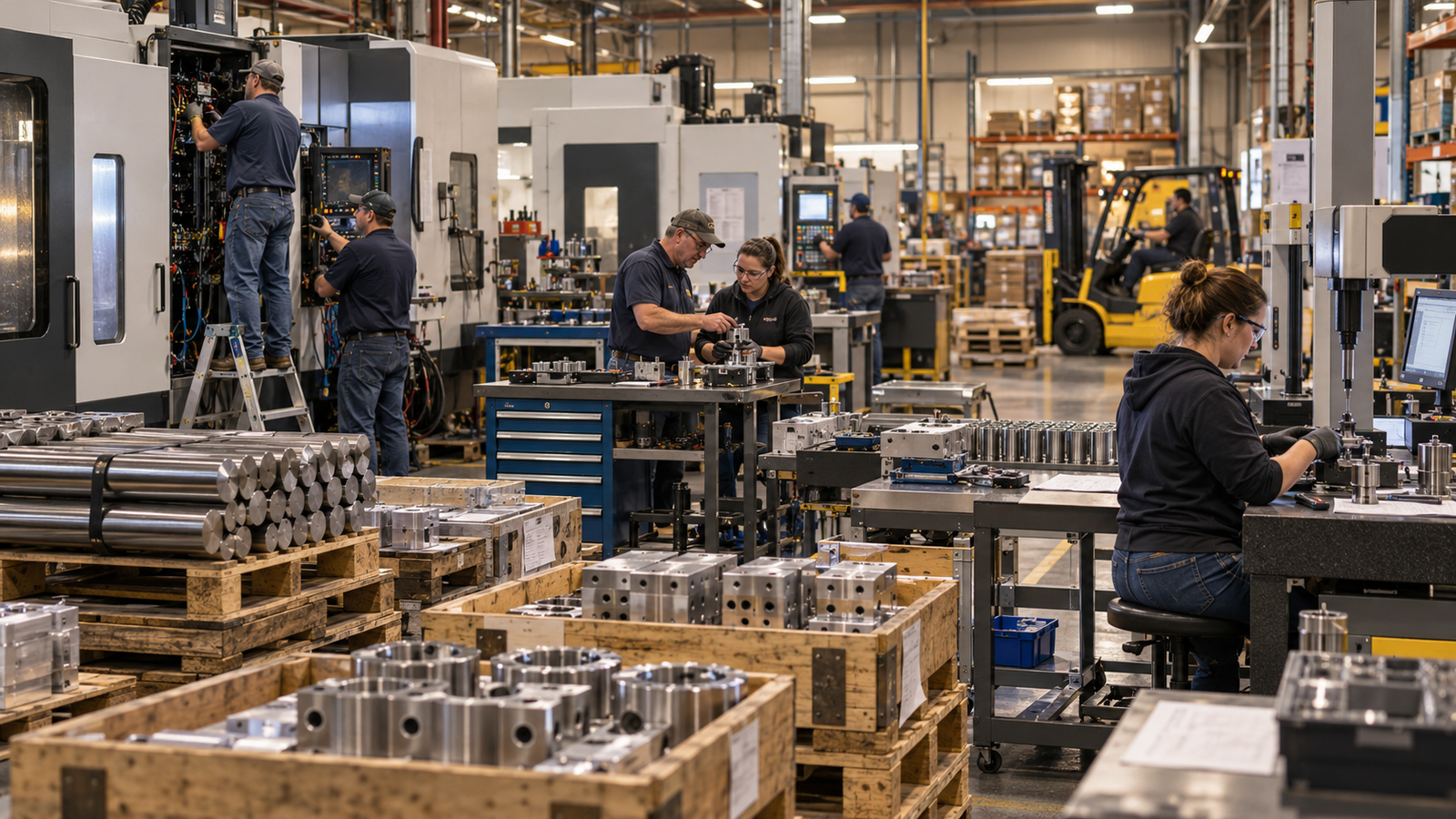
American manufacturing cannot be rebuilt overnight because manufacturing capacity is an ecosystem, not a building. A durable domestic supply chain requires skilled workers, suppliers, tooling, machines, materials, quality systems, logistics, capital, customers, and enough steady demand for companies to invest with confidence.
The short answer
Opening a factory is the visible part.
Behind that factory are dozens or hundreds of less visible capabilities: toolmakers, maintenance technicians, material suppliers, heat treaters, plating shops, textile mills, machine dealers, software specialists, quality labs, freight carriers, packaging companies, utilities, lenders, and workers who know the process.
If those capabilities have thinned out, a company cannot recreate them with a purchase order.
This is why serious reshoring takes time.
A factory needs suppliers before it makes anything
Imagine a company wants to move production of a metal product back to the United States.
The company may need domestic or regional sources for steel, castings, forgings, fasteners, coatings, packaging, cutting tools, machine service, and replacement parts. It may need a nearby heat-treatment vendor or plating operation. It may need calibrated inspection equipment and a laboratory that can verify material properties.
If one critical process is missing, production can stall.
The same problem appears in textiles.
Growing cotton is not the same as spinning yarn. Spinning is not knitting. Knitting is not dyeing. Dyeing is not cutting and sewing. Sewing is not printing. A domestic shirt requires a chain.
The weakest missing link can determine whether the whole product is practical to make here.
Equipment has lead time
Industrial equipment is not a light switch.
Machines must be selected, financed, ordered, delivered, installed, powered, programmed, tooled, tested, and maintained.
Some operations also require ventilation, compressed air, water treatment, specialized floors, cranes, clean environments, or other infrastructure.
Then the process has to be proven.
A machine that is physically sitting on the floor is not the same as a machine producing good parts at the required rate.
Ramp-up is real work.
Tooling is its own capability
Many products need molds, dies, fixtures, gauges, jigs, cutting tools, patterns, or custom workholding.
That tooling has to be designed and built by people who understand both the product and the process.
If domestic tooling capacity has been lost in a particular niche, the manufacturer may still depend on overseas tooling even after final production moves home.
That does not make the reshoring effort fake. It shows why supply chains are layered.
The deeper the domestic capability, the more resilient the production system becomes.
Skilled workers take longer than machines
A company can buy a machine with money. It cannot buy ten years of judgment instantly.
Manufacturing depends on people who can:
Set up equipment
Read drawings
Hold tolerances
Inspect parts
Maintain machines
Diagnose defects
Improve processes
Train new employees
Manage material flow
Schedule production
Solve problems when the process stops behaving
Registered Apprenticeships, technical schools, community colleges, employer training, and experienced mentors all matter because skill has to be built and transferred.
A country can lose a production line faster than it can rebuild a workforce around that line.
Quality systems have to be rebuilt too
Customers do not buy “capacity.” They buy products that meet requirements.
That means a reshored operation has to prove quality.
Suppliers may need qualification. Processes may need validation. Measurements must be repeatable. Documentation has to be created. Workers need training. Defect rates must come down. Customers may require audits or certifications.
In regulated or safety-critical industries, qualification can take much longer than the physical installation of equipment.
This is not bureaucracy for its own sake. It is the difference between “we can make one” and “we can reliably make thousands that meet the same standard.”
Capital follows confidence
Domestic manufacturing requires investment.
Companies need to believe customers will buy enough product, for long enough, to justify equipment, hiring, inventory, and supplier commitments.
That is why demand matters.
A sudden burst of patriotic buying can help a small business. A stable customer base helps it plan.
If consumers want more American manufacturing, consistency is more useful than one weekend of enthusiasm followed by a return to the lowest price at any cost.
Businesses build around predictable demand.
Scale has to be earned
A domestic supplier may start with higher prices because volume is low.
Higher prices can suppress demand.
Low demand can make it harder to justify more equipment.
That creates a chicken-and-egg problem.
The way out is not pretending economics do not exist. It is building volume in stages, improving productivity, designing products for domestic processes, developing suppliers, and choosing categories where proximity, quality, lead time, or resilience create real value.
NIST’s Manufacturing Extension Partnership works with small and medium-sized U.S. manufacturers on productivity, supply chains, technology, markets, and workforce challenges for exactly this reason: manufacturing competitiveness is a system problem.
Reshoring does not have to mean 100 percent on day one
A company can make progress in layers.
It may first move final assembly home.
Then qualify a domestic packaging supplier.
Then localize a machined component.
Then bring a second source closer to the factory.
Then invest in tooling that was previously offshore.
Then redesign the product around materials available domestically.
Partial reshoring can reduce risk and rebuild capability even when the final supply chain is not fully domestic.
Honest progress is better than fake perfection.
Consumers have a role, but not the whole burden
Consumers cannot rebuild industrial capacity by themselves.
Companies have to invest. Workers have to train. Suppliers have to improve. Lenders have to finance. Engineers have to redesign. Communities have to support industrial activity. Customers have to buy.
Consumers can help by rewarding companies that are transparent about what is made here and by giving domestic manufacturers enough repeat business to justify continued investment.
But nobody should pretend buying one American-made coffee mug rebuilt the industrial base.
This is long work.
Related questions
Why not just bring the old factories back?
Buildings may remain, but equipment, suppliers, workers, ownership, technology, and markets can change or disappear. Reopening a building does not recreate the old ecosystem.
Can automation solve the workforce problem?
Automation can improve productivity and reduce some labor requirements, but automated systems still need engineers, technicians, programmers, operators, maintenance, and process knowledge.
Is reshoring always more expensive?
Not necessarily. Companies can find value in shorter lead times, lower inventory, faster problem solving, reduced disruption risk, quality, and proximity to customers. The economics depend on the product.
What should I read next?
Read our next guide on what reshoring actually requires, including supplier mapping, total cost, phased moves, and workforce planning.
F2R takeaway: manufacturing comes back one capability, one supplier, one skilled worker, and one repeat customer at a time.