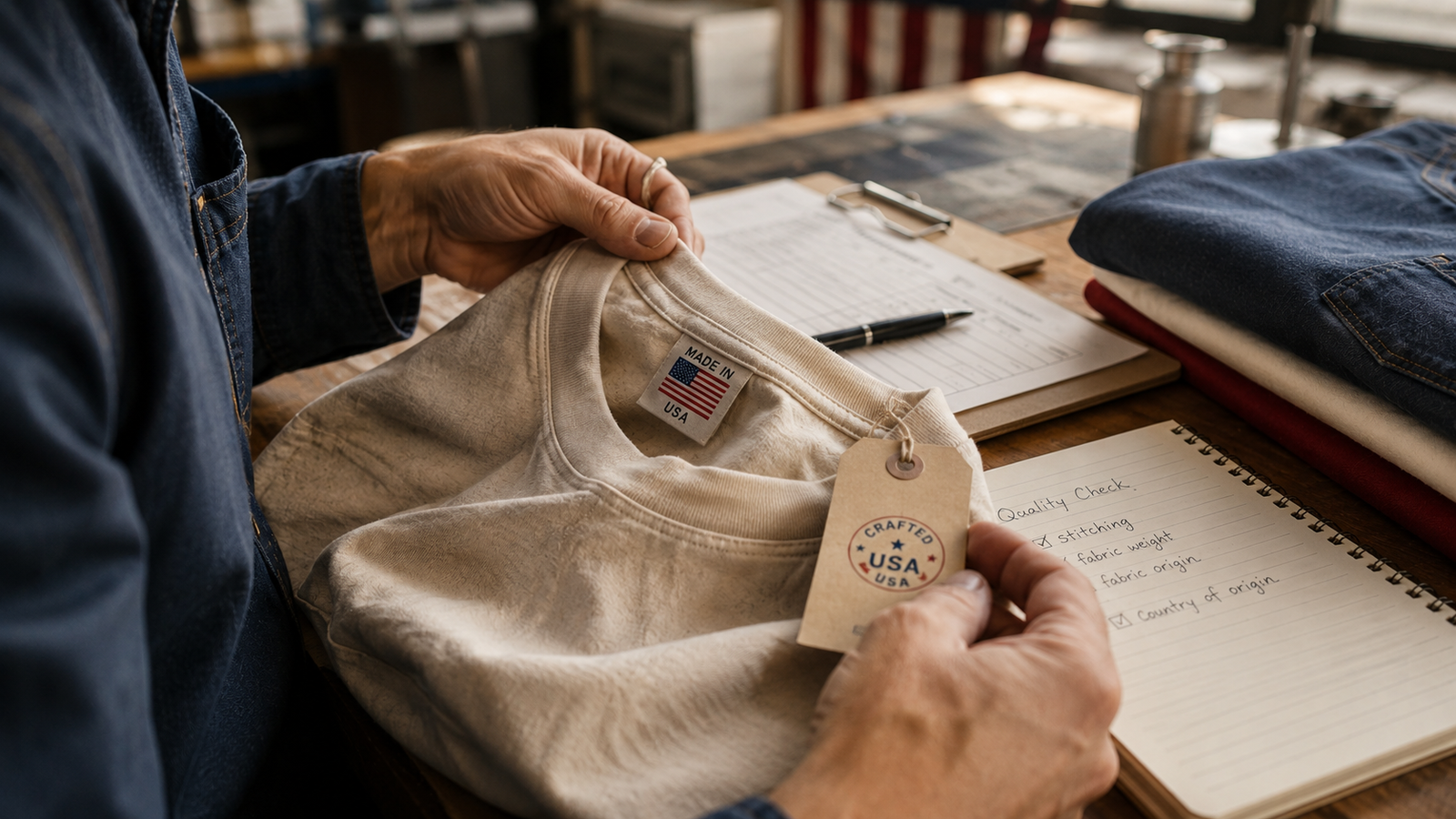
The American flag is not proof of American origin.
Neither is a company name, a patriotic slogan, a picture of a factory, or the phrase “ships from USA.”
If you want to know whether a product is really Made in America, the best place to start is the Federal Trade Commission’s standard.
Understand the phrase “all or virtually all”
For an unqualified Made in USA claim, the FTC says a product should be all or virtually all made in the United States.
That means final assembly or processing must occur here, significant processing should occur here, and all or virtually all ingredients or components should be domestic. A negligible amount of foreign content may be possible, but there is no simple percentage rule that automatically applies to every product.
Companies are also expected to have a reasonable basis for the claim before making it.
Learn the difference between an unqualified and qualified claim
“Made in USA” is an unqualified claim.
“Made in USA with imported fabric” is qualified.
“Printed in USA” identifies a specific process.
“Assembled in USA” is another kind of claim with its own requirements.
Those phrases are not interchangeable.
This matters a lot in apparel because it is common for an imported blank T-shirt to be screen printed in the United States. There is nothing inherently wrong with that business model. It simply should not be described in a way that makes the whole garment appear domestically made if it is not.
Check the manufacturer, not only the retailer
For F2R, supplier transparency is one of the easiest ways to build trust.
Bayside publicly describes U.S. knitting, dyeing, finishing, cutting, and sewing. US Blanks publishes details about its Los Angeles manufacturing and local fabric production.
A consumer can read those claims directly instead of relying only on our marketing copy.
That is exactly how it should work.
Watch for product-level exceptions
Origin and material details can vary by style or color.
A manufacturer may offer a 100 percent cotton shirt in most colors while using a cotton/polyester blend in a heather or ash color. Another product line may include imported components even when the company makes other products entirely in the United States.
So verify the specific product, not just the brand reputation.
Trust comes from being precise
F2R should never need to make the claim louder than the evidence.
If the blank is Made in USA, say so. If the cotton is American-grown and the supplier supports that claim, document it. If printing happens domestically, identify that step. If a future product contains imported material, qualify the claim rather than hiding it.
That is how “Made in America” becomes useful information instead of decoration.
Quick answer
What is the FTC standard for Made in USA? An unqualified claim should mean the product is all or virtually all made in the United States.
Does printing an imported shirt in America make the shirt Made in USA? Not by itself. “Printed in USA” is a specific process claim.
How can shoppers verify a claim? Read the exact wording, check the specific product, and look for manufacturer or supplier documentation.
Sources
- Federal Trade Commission: https:/
/ www. ftc. gov/ business- guidance/ resources/ complying- made- usa- standard - FTC Made in USA Rule: https:/
/ www. ftc. gov/ made- in- usa- rule - USA Bayside: https:/
/ usabayside. com/ about/ - US Blanks: https:/
/ usblanks. net/ pages/ american- made